We Sent a Spacecraft to "Touch" the Sun. Here’s What It Found.
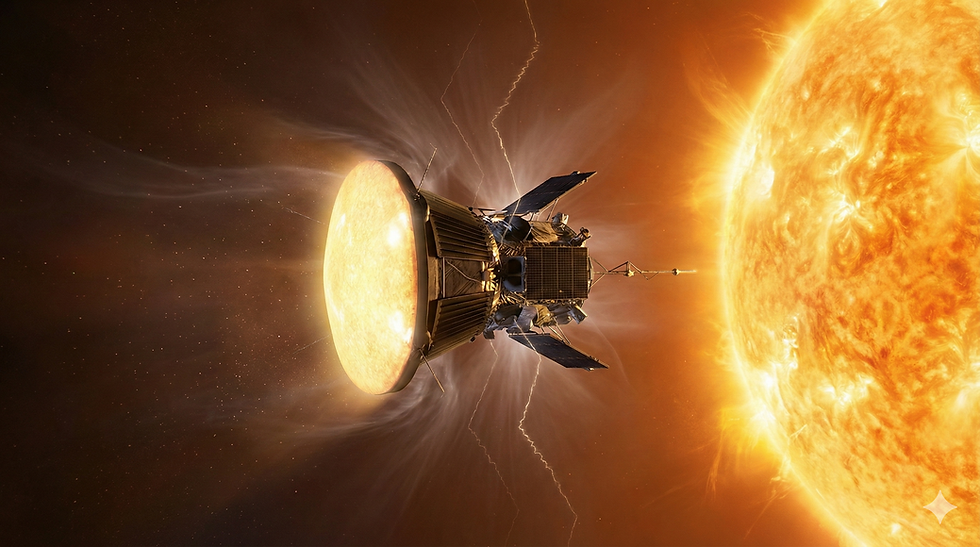
You know I’m usually obsessed with looking as far out into the universe as possible—galaxies at the edge of time, distant exoplanets, dark matter. But recently, I realized I’ve been ignoring the most powerful, terrifying thing right in our own backyard: The Sun.
I’ve always taken the Sun for granted. It rises, it sets, it keeps us warm. Boring, right?
Wrong. I recently tuned into a livestream called "New Vistas in Astronomy," and it completely changed how I see our star. The session featured Dr. Kelly Korreck talking about the Parker Solar Probe mission. And let me tell you, my excitement level went from zero to "plasma ejection" very quickly.
Meeting the Expert
Before we get into the mind-melting science, I have to fan-girl for a second over the speaker.
Dr. Kelly Korreck isn't just watching space exploration happen from the sidelines. She is an astrophysicist and a Program Scientist at NASA Headquarters in the Heliophysics Division. Holding a Ph.D. in Space Physics from the University of Michigan, she served as the head of science operations and project manager for the SWEAP instrument suite aboard the Parker Solar Probe. Basically, her entire job is to understand the mechanics of our star and how its giant magnetic outbursts affect everything in the solar system.
Seeing a woman leading in such huge, high-stakes science is honestly so inspiring to me as a junior looking at STEM careers. She explained complex plasma physics in a way that actually made sense, and her enthusiasm for flying a robot into an inferno was contagious.
The Ultimate Game of "The Floor is Lava"
The Parker Solar Probe's job is simple but terrifying: fly closer to the Sun than any human-made object in history. It’s basically a robotic moth flying straight into the biggest flame we know of.
Here are the parts of her talk that absolutely blew my mind:
1. The Indestructible Umbrella To survive flying through the Sun's outer atmosphere (the corona), the probe hides behind a massive, high-tech carbon-foam heat shield. Dr. Korreck explained that the front of that shield hits around 2,500 degrees Fahrenheit—hot enough to melt steel—while the instruments tucked safely behind it are sitting comfortably at room temperature.
2. The Speed Run It is fast. Like, unbelievably fast. At its closest approach, Parker is hurtling through space at over 430,000 miles per hour. That’s fast enough to get you from Philadelphia to Washington, D.C., in about one second. It’s the fastest human-made object ever.
3. The Magnetic Zig-Zags They found something weird called "switchbacks." Imagine the Sun's magnetic field lines streaming out like spaghetti. Parker found that these lines aren't straight; they fold back on themselves in sharp zig-zags. Flying through these magnetic kinks is giving scientists huge clues about how the "solar wind" gets accelerated to such massive speeds before sweeping across the solar system.
Hearing Dr. Korreck talk about this mission was a huge reminder that astronomy isn't just about looking at calm, distant stars. Sometimes, you have to build a spaceship, armor it up, and send it straight into the fire to get the answers you need.
You have to check out the full session to hear her explain the science and see the amazing animations of the spacecraft in action.


Comments