Why You Should Be Very, Very Grateful for the Moon Tonight
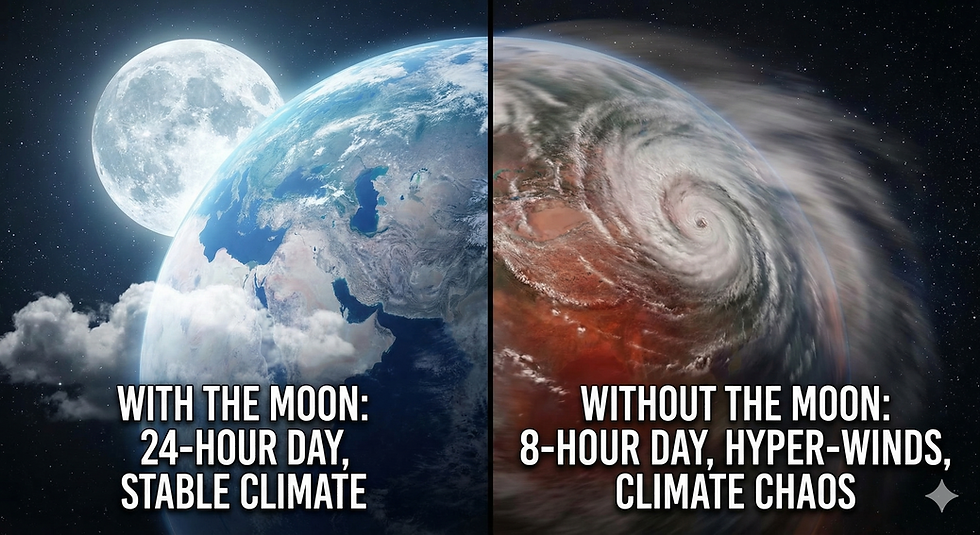
Look out your window tonight. If it’s clear, you’ll see the Moon. It looks peaceful, right? Just hanging out up there, inspiring poets, lighting up the night, and occasionally blocking out the sun for a cool eclipse.
We take it for granted. It’s just... there.
But I recently watched a talk that made me realize the Moon isn't just cosmic decoration. It is quite possibly the only reason you aren't currently being blown sideways by 200 mph winds while freezing in a chaotic ice age.
I tuned into a lecture by astrophysicist Dr. Neil F. Comins. He is literally the guy who wrote the book on hypotheticals (it’s called What If the Moon Didn't Exist?). He walked through the scenario of what would have happened to Earth if that giant, Mars-sized object hadn't smashed into us 4.5 billion years ago to form our lunar companion.
The short answer? Earth becomes a horror show.
Here are three mind-blowing things I learned from Dr. Comins about the B-movie version of Earth without a Moon:
1. The 8-Hour Day from Hell
Right now, the Earth spins once every 24 hours. It’s a nice, leisurely pace. Why? Because for billions of years, the Moon’s gravity has been acting like a subtle brake, slowing our rotation down.
Without the Moon, Dr. Comins explains, Earth would be spinning wildly fast. Our day wouldn't be 24 hours; it would be more like 8 hours.
And you know what happens when a planet with an atmosphere spins that fast? Wind. Extreme wind. We aren't talking a breezy day; we are talking constant, relentless winds of 100 to 200 miles per hour, all day, every day. Imagine living inside a perpetual Category 5 hurricane.
2. The Evolutionary roadblock
We know the Moon controls the tides. Without it, we’d still have tides from the Sun, but they would be pitifully small—about one-third the size of what we have now.
Why does that matter? Many scientists believe that tidal pools—those areas that get wet and then dry out as the tide goes in and out—were crucial laboratories for early life. It’s where sea creatures may have first adapted to survive on land. Without big tides, that crucial evolutionary step might never have happened, or it would have looked drastically different.
3. The Great Climate Wobble
This is the scariest one. Think of a spinning top. When it’s spinning fast, it stands up straight. As it slows down, it starts to wobble.
The Earth is a giant top, and the Moon acts as a stabilizer, keeping our tilt relatively steady at 23.5 degrees. This gives us our predictable seasons.
Without the Moon, Dr. Comins explained, the gravitational tugs from Jupiter and the Sun would cause Earth's axis to wobble wildly over time. We could tilt so far over that the North Pole points directly at the Sun, frying one hemisphere while the other freezes solid. Complex civilizations like ours—which rely on farming and stable weather—could never survive those kinds of chaotic climate swings.
The Takeaway
If the Moon didn't exist, humans almost certainly wouldn't exist either. At least, not looking like we do today. Any life on Earth would have to be short, sturdy, and low to the ground just to avoid getting blown away by the super-winds.
So, tonight, give the Moon a little nod of thanks. It’s doing a lot of heavy lifting up there to keep things nice and calm down here.
You have to check out Dr. Comins’ full, fascinating deep dive into this alternate reality.


Comments