Why the World’s Most Powerful Telescope is Looking... Backward?
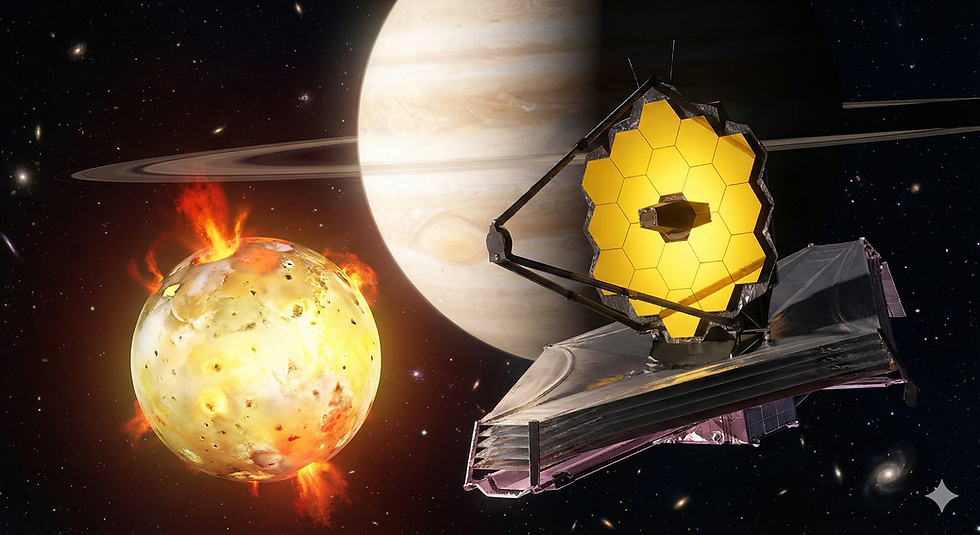
If you’ve been following the James Webb Space Telescope (JWST) news, you probably know it as the "Time Machine." We use it to look back 13.5 billion years to see the first galaxies born after the Big Bang. It’s famous for looking far, far away.
But... what if we pointed it at something right next door?
I just finished listening to the latest episode of NASA’s Curious Universe podcast, "What the Webb is Teaching us about the solar system," and it turns out, Webb isn't just looking at the edge of the universe. It’s also rewriting the textbooks on our own cosmic backyard.
This episode features Caltech astronomer Katherine de Kleer, and she breaks down why turning a deep-space telescope around to look at bright, fast-moving planets is actually way harder (and cooler) than you think.
The "Too Fast, Too Bright" Problem
Here is the catch: Webb was built to detect the faintest light from the darkest parts of the universe. Pointing it at Jupiter is like staring at the sun with night-vision goggles. It’s blindlingly bright for the sensors.
Plus, distant galaxies barely move. But planets in our solar system? They zoom across the sky.
De Kleer uses a great analogy in the podcast: It’s like driving down a highway. Trees on the horizon look like they are standing still, but the trees right next to the road blur past you. Webb had to be specially programmed to "track" these speeding objects without getting dizzy.
Volcanoes on Io (Live!)
One of the coolest things Webb is doing is watching Io, one of Jupiter’s moons. Io is the most volcanically active body in the solar system (it’s basically a pizza covered in volcanoes).
Because Webb sees in infrared (heat), it doesn't just see the smoke—it sees the lava. De Kleer explains how they can track eruptions in real-time and see how much heat is pumping out of individual volcanoes. It’s like having a thermal camera pointed at an alien world.
No Atmosphere = No Problem
Here is why this matters: When we use telescopes on the ground, Earth's atmosphere gets in the way. It’s filled with water vapor and carbon dioxide that block certain wavelengths of light.
But Webb is a million miles away, free from Earth's messy air. This means it can see "colors" of light that are invisible to us down here, revealing secrets about the atmospheres of Uranus, Neptune, and even asteroids that we’ve never seen before.
Why You Should Listen
It’s easy to get lost in the "billions of years ago" stuff, but this episode is a great reminder that there is still so much we don't know about the planets right next door.
If you want to hear how they managed to take those viral photos of Jupiter’s faint rings (yes, Jupiter has rings!), you have to check this out.
And to see the mind-blowing images they talk about, check out the official NASA page: NASA Curious Universe: What Webb is Teaching Us


Comments